 Top Trending
A 25-Milliliter Gel Pack With Thirteen Lines on the Panel and 40 Milligrams of Caffeine. Of the Thirteen, the Caffeine Is the One With a Track Record. I Went Through the Other Twelve With the Trials Open.
Focus & Recall is a single-serving gel from HealthyCell, a company in Mount Pleasant, South Carolina: a peach-and-pineapple flavored pouch you squeeze into your mouth or a glass, with three B vitamins, taurine, tyrosine, ginseng, phosphatidylserine, theanine, a plant omega-3 oil, turmeric, caffeine and huperzine A. I read every line of the panel beside the trial it came from, read the reviews, the box, the FAQ and the return page, and wrote down which lines earn their place.

This is a paid advertisement. Sponsored by Life Science Institute LLC (HealthyCell).

Curtis Vale is the pen name of this desk. The customers quoted on this page are real; their reviews are public on the seller's product page and were read there on September 9, 2026. I haven't met them and know nothing about them beyond what they wrote. The small photos beside their reviews are illustrations, not the reviewers. Everything about the gel, from the thirteen lines on the panel to the return terms, comes from the seller's own label and pages, read the same day.
I still work three days a week, and I count my caffeine the way I count my money: because I have less of both than I used to.
So the first thing I did with this gel pack was find the caffeine line.
It's near the bottom of the panel: 40 milligrams, "organic caffeine from green coffee beans."
About a cup of tea, or half a cup of coffee.
Of the thirteen lines on this panel, that's the one whose effect has been measured, regulated and agreed on for a century. The other twelve are the rest of this page.
I want to be fair to the pouch, so I'll say what it is before I say what it isn't.
It's a neat idea: one 25-milliliter gel, sealed, flavored, no water needed, that delivers a long list of things men my age buy separately and forget to take.
It tastes of peach and pineapple. Two grams of added sugar, from apple juice. Thirty calories.
Thirty pouches to the box, so a month.
Thirteen lines, one pouch, once a day. Every number on this page is for that pouch, and the honest way to read it is one line at a time.
Here's what the gel is.
A single-serving pouch from HealthyCell, a company in Mount Pleasant, South Carolina, that sells most of its supplements in this form.
The panel, in the order it prints:
vitamin B6, folate, vitamin B12, taurine, L-tyrosine, Panax ginseng root extract, phosphatidylserine, L-theanine, Ahiflower seed oil, curcuminoids from turmeric, caffeine, and huperzine A.
Twelve active lines, thirteen with the sodium the panel also lists.
Vegan, gluten-free and soy-free, the box says.
I did what I always do.
I read the label before the listing.
I read the trials behind each line, at the doses they actually used.
I read the reviews on the seller's page and kept four.
And I read the FAQ, where the seller says where the caffeine comes from, and the return page, where the seller says what you'll pay to send it back.
What I found is a well-made pouch with one line that does what it says, a few lines at a fraction of their trial doses, several lines whose trials came out empty, and a taste that most customers like.
One more thing before the first line, because most of you got here from one of our own advertisements.
Those ads talk about a boxed cereal, three foods, three drinks, and three words or phrases a man is supposed to be able to say or spell.
None of that is in the pouch, and I won't pretend it is. It's on this page, in its place: the cereal, the drinks and the word test are the tenth line, and the honest version of every headline we run is in the guide linked at the foot.
Line one · The pouchA Tan Sachet, a Peach Flavor, and a Panel With Thirteen Lines
This is what's on the counter.
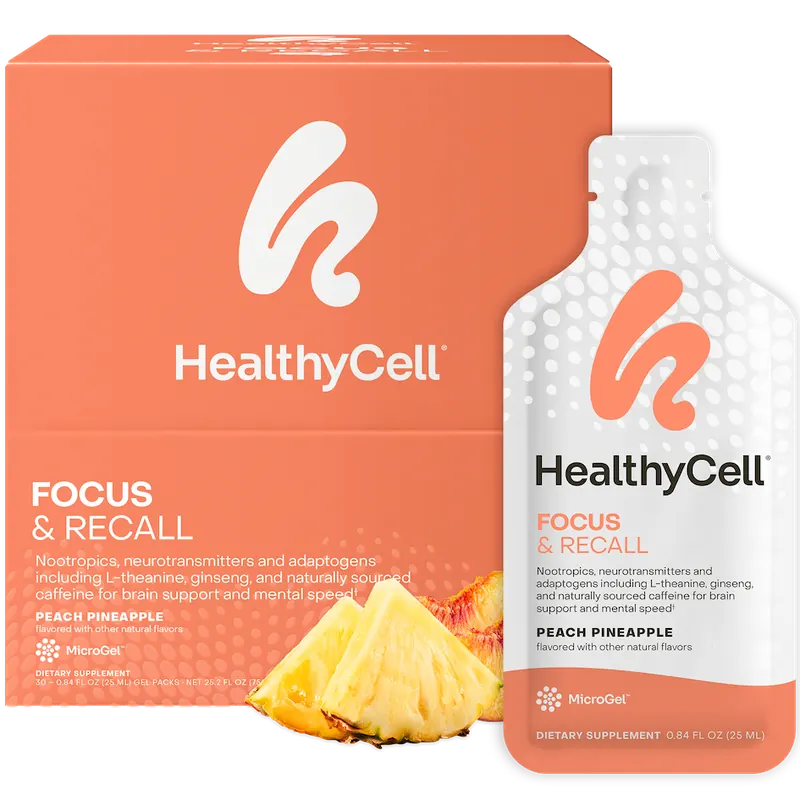
A small white box with thirty tan pouches inside, each about the size of a ketchup packet from a diner, and a little heavier.
The front of the box says Focus & Recall and lists the benefits with the dagger every supplement in America carries in place of an asterisk.
The back is the panel, and I'll read it to you in the seller's order, per pouch:
Vitamin B6, 4.3 milligrams. Folate, 400 micrograms. Vitamin B12, 4.8 micrograms.
Taurine, 500 milligrams.
L-tyrosine, 300 milligrams.
Panax ginseng root extract, standardized to 1 percent ginsenosides, 200 milligrams.
Phosphatidylserine from sunflower, 100 milligrams.
L-theanine, 100 milligrams.
Ahiflower seed oil, 65 percent omega-3, 100 milligrams.
Curcuminoids from turmeric root, 100 milligrams.
Organic caffeine from green coffee beans, 40 milligrams.
Huperzine A, 50 micrograms.
Then the other ingredients, which are the gel itself: water, glycerin, apple juice concentrate, natural flavors, citric acid, gums and pectin, a fiber called inulin, an antioxidant blend, stevia, and a pinch of minerals and pink salt.
Thirty calories. Six grams of carbohydrate, two of them added sugar from the apple juice.
The directions I found in the seller's questions page rather than the panel text I could read: you can take it daily; the effect the seller describes arrives in about half an hour and lasts two to three hours.
That half-hour-to-three-hours shape is the shape of caffeine, and the seller's own FAQ says so in its way: "40 mg, about the same as in a cup of coffee."
Line two · CaffeineForty Milligrams, the Only Line With a Century Behind It, and a Small Disagreement About Where It Comes From
I'll take the caffeine first, because it's the line that will do the most, and it's the one everybody already understands.
Forty milligrams per pouch. The label says it comes from green coffee beans.
The seller's questions page says it comes from green tea. Both are plausible sources; they can't both be the label.
Either way, it's 40 milligrams, and that's the number that matters.
Caffeine is the best-understood thing on this panel, and the story is short.
The European food-safety authority concluded in 2015 that single doses up to 200 milligrams and daily intakes up to 400 are not a safety concern for healthy adults, and that caffeine in moderate doses increases alertness and reduces sleepiness. [1]
That's the whole claim. It wakes you up, for a couple of hours.
Forty milligrams of caffeine is the pouch's track record. If you feel the pouch, this is most of what you're feeling, and it's a tenth of the daily amount the regulator considers safe.

Count it with your coffee. A pouch on top of two cups is three, and the label doesn't say so.
Line three · GinsengTwo Hundred Milligrams at One Percent, and the Extract the Trials Used at Four
The line with the most famous name, and a standardization number that matters.

Panax ginseng is the root from Korea and China, and the pouch has 200 milligrams of an extract standardized to 1 percent ginsenosides, the compounds the trials measure.

The trials I could read used a standardized extract called G115, which is 4 percent ginsenosides, four times the concentration.
In 30 healthy young adults, a single 200-milligram dose of G115 was tied to better performance on a subtraction task and less self-rated mental fatigue during an hour of hard mental work, along with lower glucose. [2]
In the same lab, eight days of 200 or 400 milligrams of G115 helped mental arithmetic at the higher dose, with no extra benefit from repeated dosing over a single dose. [3]
Two hundred milligrams at 4 percent, in young adults, for an afternoon. The pouch holds 200 milligrams at 1 percent, a quarter of the standardized compounds, in a man twice their age.
Same weight, a quarter of the strength, and trials in people half your age. That's the honest arithmetic of the ginseng line.
Line four · PhosphatidylserineOne Hundred Milligrams, and the Six-Month Trial That Came Out Even
The line with the clearest trial at the pouch's own dose, and the clearest result.
Phosphatidylserine is a fat found in every cell membrane, and in high amounts in nerve cells.
The pouch has 100 milligrams of it, made from sunflower.
Seventy-eight Japanese adults aged 50 to 69 with memory complaints took 100 or 300 milligrams a day of soy-derived phosphatidylserine, or a placebo, for six months.
Scores rose in all groups, including placebo, the way they do when you take a test twice.
Only in a subgroup with low starting scores did the phosphatidylserine groups rise more, mostly on delayed verbal recall. [4]
One hundred milligrams a day for six months, in people aged 50 to 69 who worried about their memory, did no better than placebo for the group as a whole. That's exactly the dose in the pouch.
When a line's trial at the same dose in people your age comes out even, the honest word for the line is "no." This is that line.

Line five · Theanine and tyrosineThe Tea Amino Acid, and the One That Only Works Under Pressure
Two amino acids, one small trial and one review.
L-theanine, 100 milligrams, is the amino acid from green tea that makes tea feel different from coffee, and the reason the seller pairs it with caffeine.
Its trial in people your age is a single dose: Japanese adults aged 50 to 69 with normal mental-status scores took one dose of theanine or a placebo, and the theanine group reacted faster on an attention task and made fewer errors on a working-memory task. [5]
One dose, one afternoon.
L-tyrosine, 300 milligrams, is the amino acid the body uses to make the chemicals that carry urgency.
A 2015 review of the trials concluded it seems to help performance mainly in short-term stressful or demanding situations, when those chemicals are being used up fast, and not otherwise. [6]
A quiet Tuesday at a desk isn't that situation. A tax deadline might be.
Theanine: one dose, one attention task, in people your age. Tyrosine: helps when you're being pushed hard, and not the rest of the time. Both are real; neither is a memory ingredient.
Line six · Taurine and huperzine AFive Hundred Milligrams That a Meta-Analysis Found Do Nothing, and Fifty Micrograms of a Plant Compound
Two lines I'd have left off the panel, and the trials that explain why.
Taurine, 500 milligrams, is the amino acid from energy drinks, made by the body and found in meat and fish.
A 2025 meta-analysis pooled seven randomized trials, 402 people, and found no significant effect of taurine, alone or with exercise, on cognitive scores. [7]
Huperzine A, 50 micrograms, is a compound from a Chinese club moss that acts on the same enzyme some medicines act on, which is why supplement makers like it.
In healthy adults, twelve per group, single doses of 100 or 200 micrograms inhibited the enzyme in their red blood cells; the 200-microgram dose kept declarative recall steady across the day's sessions, but neither dose improved overall performance. [8]
The pouch holds 50, a quarter of the larger dose that didn't do much.
Five hundred milligrams of taurine: a meta-analysis says no. Fifty micrograms of huperzine A: a quarter of a dose that inhibited an enzyme and didn't improve performance. Two lines, no track record.
Line seven · Turmeric and the plant oilOne Hundred Milligrams of Curcuminoids, With a Caution, and One Hundred Milligrams of Ahiflower Oil
Two plant lines with real trials, both at doses the pouch doesn't reach.
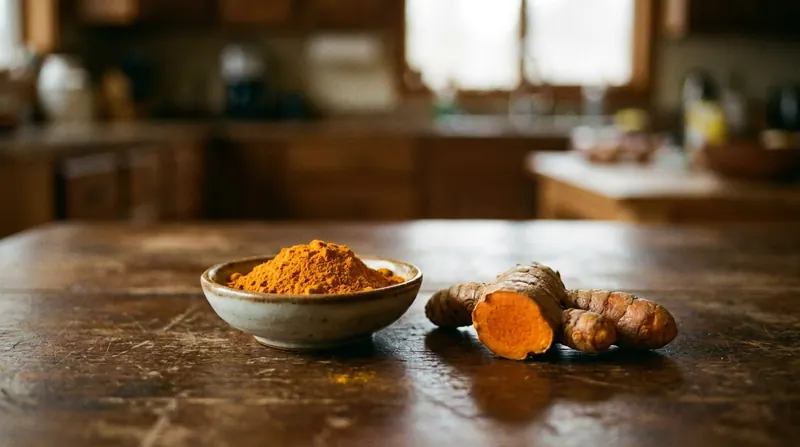
Curcuminoids, 100 milligrams, are the yellow compounds in turmeric.
The trial worth reading gave 40 adults aged 51 to 84 a highly absorbable form of curcumin, 90 milligrams twice a day, or a placebo, for 18 months, and found better verbal memory, visual memory and attention scores. [9]
That's 180 milligrams a day of a special form, for a year and a half. The pouch has 100 of ordinary curcuminoids from turmeric root, and the label doesn't say how well they're absorbed.
The National Institutes of Health adds a line I'd want you to have: it says we don't know enough to conclude whether turmeric or curcumin helps any health purpose, and that liver damage has been reported in some people who took highly absorbable curcumin products. [10]
Ahiflower oil, 100 milligrams, is a seed oil rich in a short-chain omega-3 the body converts toward EPA.
In 88 healthy adults, 9.7 milliliters a day for 28 days raised blood levels of EPA and other omega-3s, but not DHA. [11]
Nine point seven milliliters is about two teaspoons. The pouch holds 100 milligrams, roughly a hundredth of that, and the trial measured blood, not memory.
Turmeric at 100 milligrams against 180 of a special form for 18 months. Ahiflower at a hundredth of the amount that moved a blood test. Both real, both far below their trials.
Line eight · The B vitaminsThree Lines That Cochrane Already Answered
The first three lines on the panel, and the shortest section.
Vitamin B6 at 4.3 milligrams, folate at 400 micrograms and B12 at 4.8 micrograms. Generous amounts, well above a day's needs.
A 2018 Cochrane review of 14 trials in 27,882 cognitively healthy adults concluded that B-vitamin supplements, alone or combined, probably have little or no effect on global cognition for up to five years, and may have none at five to ten. [12]
Twenty-eight thousand people, and no effect in those who weren't deficient. If you're low in B12, and it's common after 60, that's a blood test and a doctor, not a peach-flavored pouch.
Count the lines that answer for themselves at their own dose, in people your age, and you get one: the caffeine. Everything else on the panel is below its trial, beside its trial, or beaten by its trial.
Line nine · The reviewsSix Hundred and One Reviews, and Four Kept
The seller's page shows 601 reviews with an average of 4.6 stars.
Each of the reviews shown on the page carries the seller's own "Verified buyer" mark. I read the ones the page showed me in its "highest rated" view.
I threw out one that described a serious health crisis and its care, because that isn't this page's business.
I kept four that talk about the pouch itself, including one that says almost nothing, because a short honest sentence is worth more than a long one.
The page doesn't show each reviewer's star count in the text I could read, so I don't print stars I didn't see.
These are real customers, quoted word for word from the seller's product page; the small photos beside them are illustrations, not the reviewers.

Great vitamins. I can tell a real difference in my cognition when I take these gel packs.

I would've kept subscribing, but I cannot consistently afford to pay for it. Could tell a difference working nights. Toward the wee hours of the morning, I could really tell that my focus and recall were better.

Taste is good. I think it helps? With L-theanine and caffeine and other components, I do think that it helps me feel more focused and alert. I don't take this daily, but I do take it a few times a week, when I'm at work or traveling.

Taste great. Good stuff.
Read those the way I did.
John says "when I take these." That's a man describing the two hours after a pouch, and I believe him.
Laura worked nights and felt the difference in the small hours, then stopped because of the price. That's the most honest review on the page: it worked in the hours caffeine works, and it costs what it costs.
Ariel says "I think it helps?" with a question mark, and takes it a few times a week when she needs it. That's exactly how I'd use it.
Lisa gives it four words.
Nobody I kept describes their memory coming back. They describe two better hours at work or on a night shift. That's what 40 milligrams of caffeine with theanine delivers, and the other eleven lines ride along.
Line ten · The bowl and the cupThe Cereal, the Three Drinks, the Three Foods and the Word Test From Our Own Advertisements
Our advertisements have been saying, in one version or another, that a boxed cereal, three foods and three drinks have something to do with memory, and that there are three words or phrases a man ought to be able to say.
You're owed the honest version, on one line, so here it is.
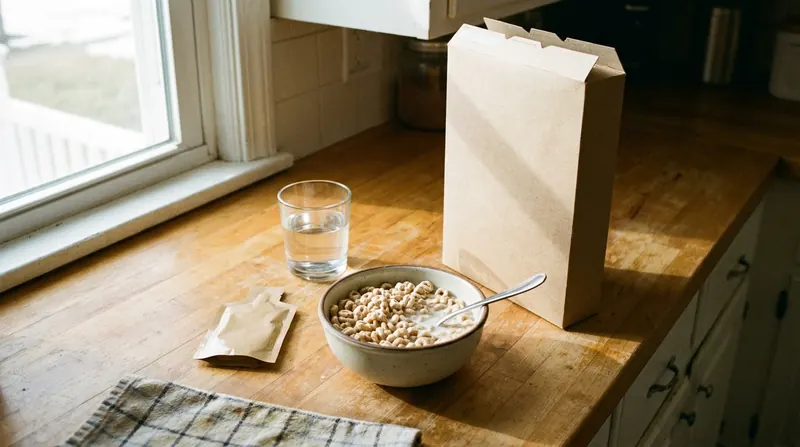
Start with the bowl.
A frosted, honey-coated or chocolate cereal is mostly refined starch and added sugar, and a serving can carry more sugar than a cookie.
No cereal "ages the brain faster than time." Nobody has measured any such thing, and that phrase was written to be clicked.
What the studies do say is duller, and worth more.
In the Framingham Heart Study, adults who drank more sugary beverages scored lower on tests of memory, and daily fruit juice went the same way. [13]
In a Brazilian study of 10,775 adults followed for eight years, the ones who ate the most ultra-processed food, and the sweet cereal shelf is part of that, lost ground on tests of thinking about a quarter faster than the ones who ate the least. [14]
Both are associations across a population, not a sentence on your bowl. And a quarter faster than slow is still slow.
This pouch has two grams of added sugar from apple juice, which I mention because the Framingham line is about juice too. Two grams is a fifth of a cookie. It's still on the label.
The three drinks.
The "evening drink" in our advertisement is alcohol, and it's the one with the strongest case behind it: in 550 British civil servants followed for thirty years, the more a person drank, the faster their scores fell on a word-fluency test, and light drinkers had no edge over those who didn't drink at all. [15]
The second is sugar in a glass: soda, sweetened tea, the tall flavored coffee from the counter, which is a soft drink with coffee in it. The Framingham finding above is about sugary drinks, and those are sugary drinks. [13]
The third, in one of our headlines, was coffee. That was our worst headline.
Plain black coffee and plain tea aren't the drinks any of those studies were about. Keep your coffee. Keep it before two, and count the pouch as half a cup of it.
The three foods.
Processed meat, fried food, and the white-flour shelf: pastries, packaged cakes, white bread.
Our advertisement says "just stop eating these three." The research says something slower.
In 960 older adults followed for nearly five years, the ones whose meals looked most like the MIND pattern, vegetables, berries, nuts, whole grains, beans, fish and olive oil, held their thinking scores better, and the gap between the top and bottom thirds worked out to about seven and a half years of age. [16]
That's a pattern over years, not a list of three, and it can't be sold in a headline. Which is exactly why our headline doesn't say it.
Less sugar in the bowl and the glass. Less alcohol in the evening. Keep the coffee. Eat more like the Mediterranean shelf and less like the vending machine. Every one of those is free, and none of them is in the pouch.
The three words, or the three phrases.
There's no such list. What our advertisement borrowed from is the short, scored mental-status test clinicians have given at the bedside since the 1970s: the date and the place, a few words to hold in mind and give back a minute later, a sum, naming, repeating one sentence, copying a drawing.
It's given in person and read against your age and your schooling by someone trained to do it, and a low score is a reason for a proper look, not a verdict.
Stumbling on a word when you're tired or being timed means nothing on its own. Nothing begins at a word.
If the worry behind the click is real, that's fifteen minutes with your doctor, and it costs you nothing from me.
And the advertisement about the things some men take every day.
That one sits closest to real research, and it's the one an advertisement has no business acting on.
Some kinds of daily medicine, including a few sold over the counter for allergies and for the night, are on the lists pharmacists check for people over 65.
Don't stop or change any of it because of an advertisement, ours included. Put everything you take in one bag, this pouch included, take it to the pharmacist, and ask one question: is anything here a poor choice at my age? Huperzine A and caffeine belong in that bag. The guide at the foot of this page has that section written out, with the studies.
So if you clicked on the cereal, here's where the cereal went: onto the counter next to a pouch that has nothing to do with it, where the real answer was always a plainer bowl and the coffee before two.
Line eleven · What it isn'tSix Things a Pouch Won't Do
- It won't do anything the caffeine isn't already doing. Forty milligrams, for two or three hours, is the line with the record; the seller's own FAQ describes the same shape.
- It won't give you the ginseng of the trials. Two hundred milligrams at 1 percent is a quarter of the standardized compounds the trial extract carried.
- It won't give you a phosphatidylserine result. Its six-month trial at this dose came out even with placebo.
- It won't act on any condition a doctor has named. It's a dietary supplement, and its own label carries the sentence that says so.
- It won't be sugar-free. Two grams of added sugar per pouch, from apple juice, on the panel.
- It won't go back for free. The seller refunds within 30 days of the order, but you return the product and pay the return shipping.
If that list annoys you, I'd rather you were annoyed now than when the box arrives from South Carolina.
Line twelve · The routineIf You Do Buy It: One Box, Thirty Pouches, the Hard Mornings Only, One Notebook
If you're going to spend the money, spend it as a test with a date on it, and test the thing that can actually work.

- Buy one box. Thirty pouches is the test, and the 30-day return window covers the box you haven't opened, not the pouches you have.
- One pouch on the mornings that need it, not every morning. Ariel's "a few times a week" is the right pattern for a caffeine product, and it makes the box last two months.
- Nothing with caffeine after two, the same as before. The pouch counts as half a cup.
- Write one line a day in a notebook. Not "sharper" or "foggier." What you were doing at ten, and how it went, on pouch days and on the others.
- Keep the coffee where it is for the first two weeks, so you know what the pouch does. Cut the afternoon cup in the third and fourth, so you know what that does.
- On day thirty, read the thirty lines. If the pouch days read better than the others, you've found a 40-milligram habit. If they don't, you've saved the subscription.
Look at that list the way I do.
Four of the six things are free.
The box is the one you'll pay for, and the notebook and the two o'clock rule are the ones that will do the work.
Line thirteen · Who it's forWho It Suits, and Who It Doesn't
This is worth a look if:
- You want a measured 40 milligrams of caffeine with theanine, in a sealed pouch that travels, for the mornings that need it, and you've now read what the other eleven lines are.
- You want a company with a street address in South Carolina, a toll-free number, and a return policy in plain words. You have all three now.
- You can hold two ideas at once: one line with a record, eleven along for the ride.
- You'll run it as a thirty-day test with a notebook, not as a hope.
- You don't mind two grams of sugar and a peach flavor.
Give it a miss if:
- You want a memory ingredient at its trial dose. There isn't one in the pouch.
- You're sensitive to caffeine, or already at your limit of coffee.
- You want something that acts on a condition a doctor has named. This is a dietary supplement.
- You take anything daily and haven't asked a pharmacist about huperzine A, ginseng and caffeine. Ask first.
- You want free returns. You'll pay the return shipping.
Line fourteen · Where it's soldFrom Mount Pleasant, South Carolina, With Free Shipping Above a Line and a Return You Pay to Ship
The pouch is sold by HealthyCell on its own website, and that's the only place this page links to.

The company is easy to find.
HealthyCell, a trade name of Life Science Institute LLC, with its office and return address in Mount Pleasant, South Carolina, a toll-free number and an email on the contact page.
The box says its production is certified and its labels are tested by an independent lab, which is more than most say.
The current price is shown on its page, not here.
The day I read it, a box of thirty cost about what a month of good coffee costs, and the subscription price was lower for those who want it.
Buy one box. Thirty pouches is a test. A subscription to something you haven't tasted is a bet.
Now the two things that matter more than the price.
First, shipping.
HealthyCell ships within the United States, free on one-time orders above the seller's minimum and on any subscription; a single box, the day I read it, was below the line, so expect a shipping charge.
Second, the return policy. Read this twice.
If you're unhappy for any reason, contact the seller within 30 days of your order; you return the product with the order number to its office in Mount Pleasant, and it refunds you within a week of receiving it.
The seller doesn't pay for return shipping. You do.
It's a real refund with a real address, and a postage bill attached. I'd rather say so than call it money-back.
Everything in a pouch
| Ingredient | Amount per serving |
|---|---|
| Vitamin B6 (pyridoxine hydrochloride) | 4.3 mg |
| Folate (L-5-methyltetrahydrofolate) | 400 mcg DFE |
| Vitamin B12 (methylcobalamin) | 4.8 mcg |
| Taurine | 500 mg |
| L-tyrosine | 300 mg |
| Panax ginseng root extract (1 % total ginsenosides) | 200 mg |
| Phosphatidylserine (Sharp-PS® Green, from sunflower lecithin) | 100 mg |
| L-theanine | 100 mg |
| Ahiflower® (Buglossoides arvensis) seed oil (65 % omega-3) | 100 mg |
| Curcuminoids from turmeric (Curcuma longa) root extract | 100 mg |
| Organic caffeine from green coffee beans | 40 mg |
| Huperzine A (from Huperzia serrata whole plant extract) | 50 mcg |
| Other ingredients: purified water, vegetable glycerin, apple juice concentrate, natural flavors, citric acid, xanthan gum, pectin, inulin, tartaric acid, antioxidant blend (natural tocopherols, rosemary extract), stevia leaf extract (reb-M), magnesium chloride, calcium phosphate, Himalayan pink salt | — |
Full details on each ingredient are in the guide linked at the bottom of this page.
The ingredient and advertising guide linked at the foot of this page goes through every one of the thirteen lines.
What each ingredient is. What the research does and doesn't show, at what dose. What to be careful about, caffeine and huperzine A first. And which of our own headlines it does and doesn't support.
Print it and take it to the pharmacist if you take anything daily. It's written for that.
See the current price on the seller's site
A 25-milliliter gel pack you squeeze into your mouth or a glass, with thirteen ingredients, 40 milligrams of caffeine and a peach-pineapple taste.
CHECK AVAILABILITYSold and shipped from South Carolina by HealthyCell (Life Science Institute LLC) · Free shipping only above the seller's order minimum or on a subscription; a single box is below it · Refund within 30 days of the order; you return the product and pay the return shipping
QuestionsWhat Readers Ask Me Before Their First Box
Questions readers ask
Is this medicine?
No. It's a dietary supplement, a flavored gel in a single-serving pouch, made for a company in South Carolina. The label carries the standard sentence every American supplement carries, the one that says the FDA hasn't evaluated its claims, and the little dagger points to it.
How much caffeine is in it?
Forty milligrams per pouch, printed on the panel. About a cup of tea, or half a cup of coffee. The label says it comes from green coffee beans; the seller's FAQ says green tea. Count it with your coffee either way.
Which of the thirteen lines actually does something?
The caffeine, with the theanine beside it. Ginseng is at a quarter of the trial extract's strength, phosphatidylserine's trial at this dose came out even, taurine's meta-analysis found nothing, huperzine A is at a quarter of a dose that didn't improve performance, turmeric and the plant oil are far below their trials, and the B vitamins do nothing in people who aren't deficient. It's all on this page, line by line.
Does it have sugar?
Two grams of added sugar per pouch, from apple juice concentrate. Six grams of carbohydrate and thirty calories in all.
What does it taste like?
Peach and pineapple, the seller says, and the reviews mostly agree it tastes good. You squeeze it straight into your mouth or into a glass.
Will it help my memory?
I can't tell you that, and you should be wary of any page that does. No line on the panel matches a memory trial in people your age at its own dose. What the customers I kept describe is two better hours at work or on a night shift, which is what 40 milligrams of caffeine delivers.
Can I take it alongside what I already take?
Ask your doctor or pharmacist and take the ingredient guide with you. Huperzine A acts on an enzyme some medicines act on, ginseng and caffeine are worth a mention if you take anything for the heart or for glucose, and turmeric extracts have a liver note from the NIH. Two minutes at the pharmacy counter answers all of that.
Which reviews did you leave out, and why?
Of the reviews the page showed me, one that described a serious health crisis. The four I kept are quoted word for word, including the four-word one. The page carries a "Verified buyer" mark on each, and I don't print stars I didn't see.
Does it ship to me?
Within the United States, from South Carolina. Free above the seller's minimum or on a subscription; a single box is below it.
What if it arrives and I don't like it?
Contact the seller within 30 days of your order and send the product back with the order number. The refund comes within a week of its arrival. You pay the return shipping.
Your advertisement was about a cereal, or three foods, or three drinks. Where is that on this page?
On line ten, in full, with the studies. The short version: less sugar in the bowl and the glass, less alcohol in the evening, keep your plain coffee before two, and eat more like the Mediterranean shelf. None of it is in the pouch, and the ingredient and advertising guide at the foot goes through every headline we run and says which ones overstate.
Your advertisement said something about three phrases, or spelling three words. Is there a test I can take?
Not on a screen. The words and phrases come from the short mental-status test clinicians give in person, and it's read against your age and schooling by someone trained to do it. Nothing begins at a word. If the worry behind the click is real, ask your doctor for the proper test. It's fifteen minutes.
The short versionEverything Above, in Sixty Seconds
- A box of 30 single-serving gel pouches from HealthyCell of Mount Pleasant, South Carolina: three B vitamins, taurine, tyrosine, ginseng, phosphatidylserine, theanine, a plant omega-3 oil, turmeric, caffeine and huperzine A, in a peach-and-pineapple gel with two grams of added sugar.
- One pouch, 25 milliliters, squeezed into your mouth or a glass. Forty milligrams of caffeine, about half a cup of coffee.
- Caffeine: the one line with a record; moderate doses increase alertness, and up to 400 milligrams a day is considered safe. [1] Ginseng: 200 milligrams at 1 percent against a trial extract at 4. [2] Phosphatidylserine: its six-month trial at 100 milligrams came out even. [4] Taurine: a meta-analysis found nothing. [7] Huperzine A: a quarter of a dose that didn't improve performance. [8] B vitamins: Cochrane found nothing in people who aren't deficient. [12]
- Six hundred and one reviews, average 4.6; the four I kept say "when I take these," "working nights," and "I think it helps?"
- Ships from South Carolina; free above the seller's line or on subscription; refund within 30 days of the order, with the return shipping on you.
- The cereal, three drinks, three foods and the word test from our own advertisements, on line ten: less sugar, less alcohol, keep the coffee before two, more like the Mediterranean shelf, and no test on a screen. None of it is in the pouch.
- The honest use: a measured 40 milligrams for the mornings that need it, not every morning, with a notebook, and thirty days to decide.

The last lineWhat a Pouch Is Actually Worth
Here's the whole thing in one breath.
Thirteen real lines in a well-made pouch, from a company that prints every one of them and tests its labels.
One line with a record: 40 milligrams of caffeine, for two or three hours.
Eleven lines below their trials, beside their trials, or beaten by them.
And 601 customers, the most honest of whom worked nights, felt the difference in the small hours, and stopped because of the price.
If you're a man who wants a measured half-cup of caffeine with theanine in a sealed pouch for the mornings that need it, that's worth a thirty-day test.
Not because of the other eleven lines. Because you'll know exactly what you're taking and when.
Buy one box, not a subscription, use it on the hard mornings only, and write one line a day for thirty days. The notebook is a better judge than I am.
Check the current price and availability
A 25-milliliter gel pack you squeeze into your mouth or a glass, with thirteen ingredients, 40 milligrams of caffeine and a peach-pineapple taste.
CHECK AVAILABILITYSold and shipped from South Carolina by HealthyCell (Life Science Institute LLC) · Free shipping only above the seller's order minimum or on a subscription; a single box is below it · Refund within 30 days of the order; you return the product and pay the return shipping
P.S. If you take one thing from this page, take the two numbers. Forty milligrams of caffeine, the one line with a record. One hundred milligrams of phosphatidylserine, the one line whose trial at this exact dose in people your age came out even. Everything else about this pouch sits between those two.
P.P.S. If the afternoon fog has been with you for a year, and it's there before the coffee too, talk to your doctor before you buy anything. A pouch on a hard morning is a small habit. It was never going to answer a question a doctor answers in fifteen minutes.
P.P.P.S. And if you do order it, keep the notebook, and keep the pouch before two. When the box is empty, you'll have thirty lines about your own mornings, pouch days and plain days, and that's worth more than the box, whichever way the lines turn out.